

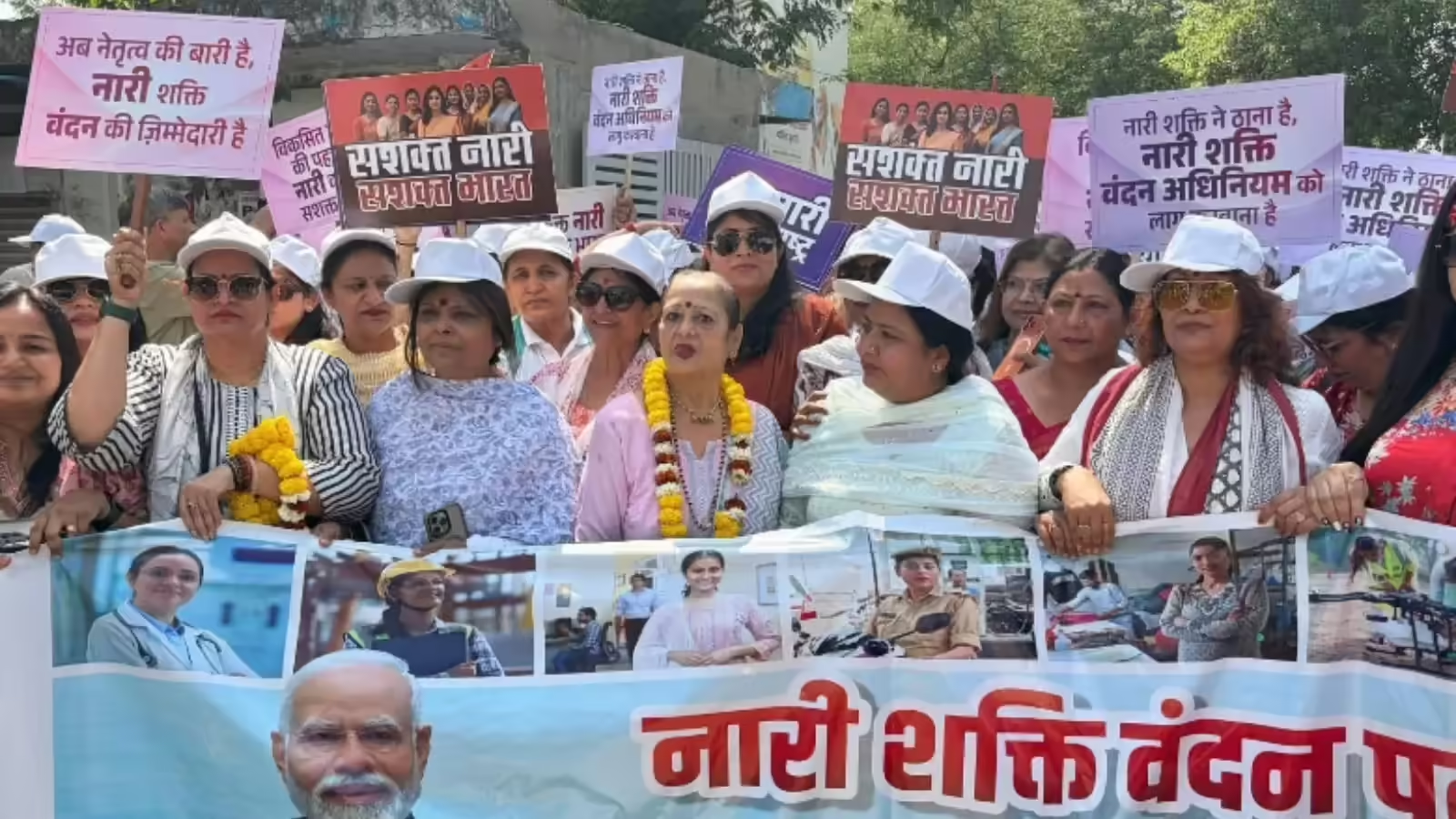
When the Women’s Reservation Bill, 2023, popularly known as the Nari Shakti Vandan Adhiniyam, was passed, it was celebrated as a historic moment. After decades of debate, India had finally committed to reserving 33% of seats for women in the Lok Sabha and State Assemblies.
It felt like a breakthrough. But three years later, in 2026, that breakthrough feels… distant. Because the truth is simple: the law exists, but its impact does not: at least not yet.
A Promise That Comes With a “Later”
At first glance, the bill looks decisive. But tucked within it is a condition that changes everything. its implementation depends on the next Census and delimitation exercise. In practical terms, this means reservation may not come into effect for several years, possibly even into the next decade. the timeline could stretch far longer than what the initial celebration suggested.
And that raises a fair question:
If a reform is always pushed to the future, is it really a reform?
India has, after all, been discussing women’s reservation since the 1990s. The 2023 law was supposed to end that cycle of delay—not continue it in a more sophisticated form.
2026: When Things Got Complicated Again
Just when it seemed like implementation might move forward, 2026 brought another twist.
The government attempted to fast-track the process by linking women’s reservation with delimitation and expansion of parliamentary seats. On paper, this may have looked efficient—combine two major reforms into one.
In reality, it opened a political Pandora’s box.
Reports from Reuters and The Guardian highlight how the proposal ultimately failed in Parliament, facing strong opposition.
But here’s the interesting part—the opposition wasn’t against women’s reservation itself. It was against tying it to delimitation.
Why? Because delimitation is not just a technical process. It determines who gets how much political power. States in the south feared that population-based redistribution could reduce their influence compared to northern states.
So, a reform meant to empower women ended up being caught in a larger debate about federal balance and political representation.
The Real Issue: Too Many Conditions
The more you look at the bill, the clearer the problem becomes.
It is not that India disagrees with women’s reservation. There is broad political support for it. The issue is that the reform has been made conditional on too many moving parts. First, it depends on the Census. Then, on delimitation. Lastly, on political consensus around how delimitation should happen.
At each step, there is room for delay. And delays, in Indian policymaking, have a way of stretching indefinitely.
But Even If It’s Implemented… Who Benefits?
Let’s assume everything goes as planned and reservation is finally implemented.
Even then, an important question remains:
Which women will actually benefit?
The current framework ensures reservation within SC and ST categories, but it does not include a separate quota for Other Backward Classes (OBCs).
Critics have pointed out that this could lead to uneven outcomes, where women from relatively privileged backgrounds gain more access to political power than those from marginalized communities. Concerns have also been raised about whether minority women will see meaningful representation anytime soon, as discussed in this Times of India report.
In other words, representation alone does not guarantee inclusion.
The Political Paradox
Here’s where things get slightly ironic.
Almost every political party in India supports women’s reservation—at least publicly. Yet, very few parties voluntarily give tickets to women in large numbers.
Even today, women make up only about 14–15% of Parliament.
So, on one hand, there is agreement that representation should increase, On the other hand, there is hesitation to make that change without a legal compulsion.
It suggests something deeper:
the idea of women’s reservation is politically acceptable—but its implementation is politically inconvenient.
We’ve Seen This Work Before
What makes the delay even more frustrating is that India already has a successful model.
Reservation for women in Panchayati Raj institutions has significantly increased participation at the grassroots level. It hasn’t been perfect, but it has undeniably changed the landscape of local governance.
Women have entered politics, gained experience, and in many cases, influenced decision-making in meaningful ways.
So, the argument that reservation is risky or untested doesn’t really hold anymore.
The real issue is not whether it works—but whether there is enough will to implement it at higher levels.
Beyond Numbers
Of course, representation is only one part of the story.
Women in India still face structural barriers—limited access to education, economic inequality, and social constraints that shape political participation.
India continues to rank low on gender equality indicators globally.
So even if reservation is implemented, it cannot, on its own, solve these deeper issues.
But that doesn’t make it any less important.
If anything, it makes it more urgent. Because political representation is often the starting point for broader change—not the end of it.
An Honest Take
At this point, it’s hard to ignore the pattern.
The Women’s Reservation Bill is widely supported. It is frequently celebrated. But when it comes to actual implementation, it is repeatedly delayed, complicated, or tied to other processes.
That raises a difficult but necessary question:
Is the delay really unavoidable—or is it convenient?
Because from the outside, it increasingly feels like India is comfortable with the idea of women’s empowerment, but less so with its immediate reality.
A Promise Still Waiting
The Women’s Reservation Bill could reshape Indian democracy. It has the potential to make governance more representative, more inclusive, and arguably, more responsive.
But right now, it remains a promise—one that has been made, celebrated, and then quietly postponed.
And perhaps that is the most telling part because India doesn’t lack agreement on women’s reservation.
It simply hasn’t decided that the time for it is now.