

Case Comment- Padam Mehta & Anr. v. State of Rajasthan (2026) INSC 476
The Supreme Court’s landmark ruling on Rajasthani finally names what decades of executive inaction refused to admit: denying a child education in their mother tongue is a violation of fundamental rights — and the case for Eighth Schedule inclusion has never been stronger.
On 12 May 2026, the Supreme Court of India did something that the Parliament has conspicuously avoided doing for over seventy years. It formally acknowledged, in constitutional terms, that Rajasthani is a real language spoken by real people with real rights — and that the State’s decades-long indifference to those rights is no longer constitutionally tolerable. The judgment in Padam Mehta and Another v. State of Rajasthan and Others (2026 INSC 476), delivered by Justices Vikram Nath and Sandeep Mehta, is more than a directive to a state government. It is a constitutional reckoning with what it means to belong to a language that official India has long pretended does not exist.
The Language the Census Erased
To understand what was decided, you first have to understand what was at stake — and that requires confronting an uncomfortable truth about how Indian officialdom has treated Rajasthani. Despite being spoken by approximately 25.8 million people as a mother tongue according to the 2011 Census, Rajasthani does not exist as a language in Indian official records. It is lumped under “Hindi” — a classification that scholars at The India Forum have described as a systematic distortion of India’s true linguistic landscape.
The irony is hard to miss. As The Wire has argued, classifying Rajasthani as a dialect of Hindi is about as defensible as calling Latin a dialect of Italian. Rajasthani — encompassing varieties such as Marwari, Mewari, Dhundhari, Shekhawati, and Harauti — has its own distinct phonology, grammar, and a literary tradition that predates modern Hindi by centuries. Medieval poet-saints like Mirabai composed in Rajasthani. The Sahitya Akademi, India’s National Academy of Letters, confers awards in Rajasthani. International linguistic databases like Ethnologue and Glottolog classify it as a distinct Western Indo-Aryan grouping.
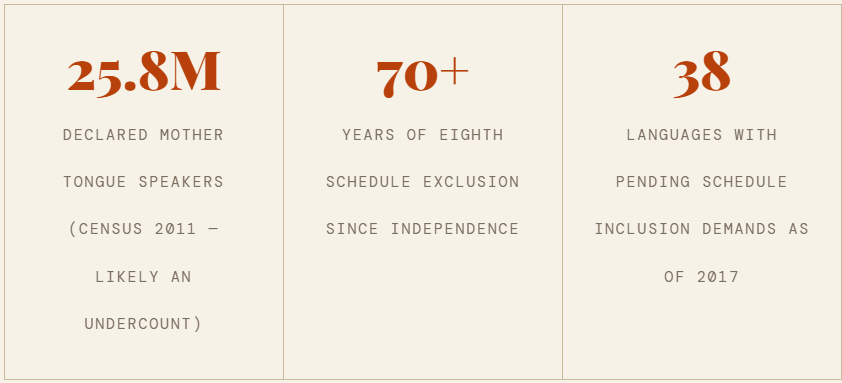
And yet, Rajasthani has never made it into the Eighth Schedule to the Constitution — the list of 22 officially recognised languages that triggers Union support, promotion, and institutional backing. The Rajasthan Legislative Assembly passed a resolution in 2003 demanding recognition. Civil society movements have been active for decades. The Ministry of Home Affairs has itself acknowledged 38 pending demands, with Rajasthani among them. Nothing has moved. No transparent criteria exist for Schedule inclusion. The process is, as scholars note, largely political — driven by lobbying rather than principle.
The Case That Broke the Deadlock
The immediate trigger for the Supreme Court’s intervention was relatively narrow. Petitioners Padam Mehta and another had filed a PIL before the Rajasthan High Court seeking two things: the inclusion of Rajasthani in the syllabus of the Rajasthan Eligibility Examination for Teachers (REET) 2021, and directions for primary education to be imparted in local dialects. The High Court dismissed the petition, holding that a writ of mandamus could not be issued without an established legal right and a demonstrated statutory failure.
The Supreme Court disagreed — emphatically. While noting that the REET 2021 cycle had already concluded (making that specific prayer infructuous), the bench held that the broader constitutional questions were far too significant to be dispatched on a technicality. What followed was a judgment that reframed the entire debate.
“The ability to understand and be understood in one’s own language is not merely a convenience; it is an existential right, inseparably tied to a person’s ability to meaningfully participate in society.”
The Court located the right to mother-tongue education at the intersection of three constitutional provisions. Article 19(1)(a) — freedom of speech and expression — was held to encompass the right to receive information in a form that is meaningful and comprehensible. Article 21A, the right to education, was understood to require quality education — and education delivered in an incomprehensible language cannot, on this logic, be quality education. Article 350A, which obligates states to provide primary education in the mother tongue to linguistic minorities, was given genuine teeth. Rajasthani speakers, the Court held, are a linguistic minority within Rajasthan — because Hindi, not Rajasthani, is the State’s official language.
The Eighth Schedule Trap — and How the Court Escaped It
The State of Rajasthan’s central argument was that it could only teach languages listed in the Eighth Schedule in its schools. This position — which the bench called “myopic” and a “pedantic approach” — reflects a broader and deeply problematic conflation that has allowed governments across India to defer linguistic obligations indefinitely.
The Eighth Schedule governs official languages for Union administrative purposes. It says nothing about restricting school instruction to listed languages. Article 350A operates entirely independently, and it extends to all linguistic minorities regardless of Schedule status. By treating the two regimes as coextensive, the State had constructed a Catch-22: Rajasthani could not be taught because it wasn’t on the Schedule, and it couldn’t get on the Schedule because it lacked the institutional support that teaching would provide.
The Court demolished this circularity by pointing to something embarrassingly obvious: Rajasthani is already taught as an academic subject at the University of Rajasthan, Jai Narain Vyas University (Jodhpur), and Maharaja Ganga Singh University (Bikaner). If a language is academically legitimate enough for university study, there is no principled basis — constitutional or otherwise — for keeping it out of primary classrooms.
The Court also identified something more troubling: an Article 14 problem. Languages such as Gujarati, Punjabi, Sindhi, and Urdu — none of them the State’s official language — were included in the REET syllabus while Rajasthani was excluded. The Court characterised this as “hostile and invidious discrimination.” The State offered no rational basis for the distinction. There was none.
What the Court Ordered
The directions issued by the bench are specific and time-bound. The State of Rajasthan must formulate a comprehensive policy to implement mother tongue-based education in line with the National Education Policy 2020. It must formally recognise Rajasthani as a regional language for educational purposes. It must introduce Rajasthani as a compulsory subject in all government and private schools in a phased manner, beginning at the foundational stage. A compliance affidavit is to be filed by 25 September 2026.
These are significant directions. They do not merely recommend — they mandate. And they carry the authority of a Supreme Court bench that framed this not as a policy preference but as a constitutional obligation.
Why This Judgment Demands Eighth Schedule Action
The judgment is directly about education, not about the Eighth Schedule. But read carefully, it makes the case for Schedule inclusion more urgent and more legally compelling than at any point in Rajasthani’s long advocacy history.
The Court has now authoritatively found that Rajasthani speakers form a distinct linguistic group whose rights are enforceable under the Constitution. It has found that the State’s administrative neglect amounts to a constitutional violation. It has found that the absence of Eighth Schedule status cannot justify inaction on mother-tongue education. Each of these findings carries logical implications that reach beyond the educational context.
If Rajasthani speakers have enforceable constitutional rights as a linguistic minority, then the Union’s failure to include their language in the primary mechanism through which it promotes and develops recognised languages — the Eighth Schedule — is constitutionally incongruous. The Union’s own legislative commitments, through Section 29(2)(f) of the RTE Act and the NEP 2020, acknowledge the primacy of mother-tongue instruction. The Sahitya Akademi already treats Rajasthani as a literary language. Universities across the state teach it. The language has speaker numbers larger than the populations of several European nation-states.
What, precisely, is the remaining justification for exclusion? As The Wire has argued, a principled approach would set a clear speaker threshold — say, one million native speakers — above which inclusion would be automatic, removing the political discretion that has allowed the Schedule to function as a gatekeeping tool rather than a recognition mechanism. Rajasthani would qualify under any such threshold by an order of magnitude.
The Unanswered Questions
The judgment is not without its limitations and open questions. The most practical challenge it does not fully resolve is standardisation. Rajasthani is internally diverse — which variety becomes the medium of instruction? Marwari (the most widely spoken), or a composite standard? This is a genuine administrative challenge, but it is not a constitutional excuse for inaction. Konkani and Sindhi navigated standardisation debates without their Schedule status being withheld. The Rajasthan Sahitya Akademi and the state’s universities have already developed pedagogical material in standard Rajasthani, providing an institutional starting point.
There is also the compliance question. The Court has asked for an affidavit by September 2026. Indian constitutional history offers cautionary examples: mandates in linguistic and educational matters have sometimes been acknowledged on paper and deferred in practice. Sustained oversight — judicial and civil society — will be essential.
Finally, the judgment’s broad holding that mother-tongue education is an enforceable fundamental right has implications that go well beyond Rajasthani. India has hundreds of non-Scheduled languages with significant speaker populations. The People’s Linguistic Survey of India warns that India has lost nearly 50 languages in the past five decades, with over 400 more at risk. If the Padam Mehta framework is taken seriously, it creates a constitutional obligation toward all of these communities — an obligation whose resource implications are substantial and whose political difficulty is real.
The Larger Meaning
Somewhere in Jodhpur, a child goes to school and cannot understand what the teacher is saying — not because she is inattentive or incapable, but because the language of instruction is not the language of her home, her neighbourhood, her songs, her grandmother’s stories. The Supreme Court has now said, plainly and authoritatively, that this is not a misfortune to be managed. It is a constitutional wrong to be remedied.
Rajasthani has waited long enough. The language of Mirabai — which predates Hindi, which sustained an entire civilisation’s literary memory, which is still spoken by tens of millions of people across one of India’s largest states — deserves more than administrative negligence dressed up as neutrality. The Court has given the State a deadline. Now it is time for Parliament to act on the larger question that this judgment cannot answer alone: the Eighth Schedule inclusion that Rajasthani has earned, and that seventy years of democratic governance has failed to deliver.