

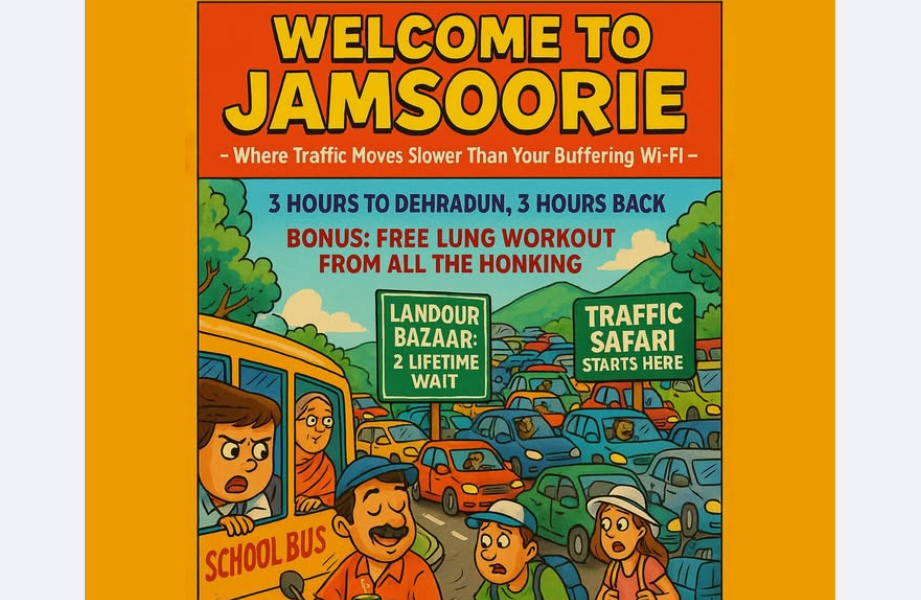
A road built to impress. The hills it leads to, slowly dying.
On April 14, 2026, Prime Minister Narendra Modi inaugurated the Delhi–Dehradun Expressway — a ₹13,000 crore, 210-kilometre, six-lane access-controlled corridor that slashes travel time between the two cities from five to six hours down to a promised 2.5 hours. The photo-ops were gleaming. The headlines were triumphant. And somewhere on the winding road above Dehradun, in the crush of Delhi and Haryana number plates inching toward Mussoorie, a hill station exhaled what might be its last quiet breath.
Because nobody — not NHAI, not the Uttarakhand government, not the policymakers who spent years building this road, failed to ask: what happens on the other end?
The Promise: Speed as an End in Itself
The expressway is, in purely engineering terms, impressive. It begins at Akshardham in Delhi, slices through Baghpat, Shamli, and Saharanpur in Uttar Pradesh, and ends in Dehradun. It includes a 12-kilometre elevated wildlife corridor — Asia’s longest — over Rajaji National Park, designed to allow elephants and deer to cross safely beneath the highway. Camera traps have already recorded over 40,000 wildlife crossings in the first 40 days. That detail has been celebrated, rightly so.
But the celebration of the expressway’s ecological thoughtfulness around Rajaji makes the ecological thoughtlessness about everything beyond it all the more glaring. The moment traffic exits that elevated corridor, it pours directly into a city — and a region — that was already collapsing under its own tourism weight before anyone cut the ribbon.
What Was Already Broken Before April 14
Let’s be clear about the situation in Dehradun before a single car used the new expressway.
As of April 2025, over 1.05 million vehicles were registered in the city, with a staggering 94% of those being private vehicles. Public transport accounts for barely 2.26% of the city’s vehicle fleet. And Dehradun’s road network was not designed for this. Not even close.
In November 2025 — months before the expressway opened — an investigation found that Dehradun’s major junctions were operating at nearly six times their design capacity. Ghantaghar, for instance, was built for 3,600 PCUs (Passenger Car Units) of traffic. It was recording 14,282. Prince Chowk, designed for 2,900, was seeing 17,090. Lalpul, also designed for 2,900, was bearing 16,664. The same report noted that the Doon ring road — a key project that would have redistributed traffic before the expressway opened — had been delayed, leaving the city’s arteries completely exposed.
The government knew. Experts warned publicly. Nothing was done in time.
Now, with the expressway adding inflow to an already overwhelmed city, traffic jams in Dehradun accumulate over 83,000 jam-hours daily. Approximately 58,000 to 60,000 litres of fuel are wasted every single day, just idling in gridlock. The city, which took from 2004 to 2025 to grow its vehicle count from 70,000 to over a million, is now being asked to absorb an accelerated surge it has no infrastructure to handle.
Mussoorie: The Queen of Hills, Slowly Dethroned
Thirty kilometres up the mountain from Dehradun sits Mussoorie — the “Queen of Hills,” a colonial-era town of around 30,000 permanent residents spread across 64 square kilometres of ridge, never designed to be a mass tourism destination.
Yet tourist numbers doubled from 11 lakh in 2022 to over 21 lakh in 2024 — before the expressway. Hotels report water scarcity. Roads choke on weekends. Ambulances cannot get through. On peak summer days, the administration has been forced to turn away over 4,000 tourist vehicles lining up at the base of the hill, simply because there is nowhere to put them.
The National Green Tribunal’s own expert panel warned in 2023 that Mussoorie risked going the way of Joshimath — the hill town that literally began sinking into the earth in January 2023, with over 600 houses developing cracks due to unplanned construction, heavy tourism infrastructure, and total disregard for the geological fragility of the site. The NGT panel recommended regulating tourist inflow based on the town’s carrying capacity, and charging entry fees to fund waste management.
The response from the state? In August 2025, Uttarakhand introduced a mandatory digital tourist registration system for Mussoorie during peak season — a scramble, a patch job, a QR code standing in for actual urban planning. Carrying capacity surveys began only recently. And all of this was put in place while simultaneously a ₹13,000 crore expressway was being completed to funnel even more traffic toward this already overwhelmed town.
The irony barely registers in the policy documents.
Rishikesh: The Holy City Gasping
Downstream from the mountains, Rishikesh tells a similar story — just louder and more chaotic.
In 2023, tourist arrivals crossed 1.04 million. By 2024, they touched 970,000 — each year, more than three times the local population of roughly 300,000. The city has no dedicated city bus service. All movement depends on shared autos, Vikrams, and private vehicles. The two main roads — a highway and a bypass — form the spine of an entire city, and they are narrow, crumbling, and overwhelmed.
Air quality monitoring at high-footfall locations consistently records PM10 levels between 150 and 170 µg/m³ and PM2.5 between 70 and 86 µg/m³ — both above permissible limits. The Ganga, whose banks Rishikesh is built upon, faces continuing pressure from untreated sewage and religious offering waste, even as programmes like Namami Gange work to reverse some of the damage.
The expressway now makes Rishikesh accessible from Delhi in roughly three hours. For a city that already cannot absorb the tourist pressure it receives, this is not an upgrade. It is an acceleration toward a wall.
The Killing of the Taxi Economy
There’s a subtler damage unfolding alongside the ecological one — the erasure of a local economy built around shared, public-ish transport.
Before the expressway, travel from Delhi to Uttarakhand involved effort. The six-hour journey on NH-7 meant that most people either took trains, booked shared taxis, or hired local cab services. The friction of the journey naturally filtered out casual, impulsive weekend traffic. It created a rhythm: people arrived by bus, hired local taxi drivers, supported the regional transport ecosystem. Drivers who knew every bend in the Mussoorie road. Guides who lived in Rishikesh.
Now, look at the parking lots. Look at who is arriving. Rows of Haryana and Delhi number plates — private cars, each carrying a family that has driven themselves up, bringing everything they need from the plains, stopping at whatever highway dhaba caught their eye, and leaving behind only their garbage.
The local cab driver in Dehradun, who once ferried tourists from the railway or bus station up to Mussoorie or Rishikesh, has seen his livelihood quietly disappear. Why hire a local taxi when you drove your own car? Why depend on shared transport when the expressway makes a personal vehicle the obvious choice?
This is not a minor inconvenience for a few drivers. It is a structural economic blow to the people who live in and around these hill towns — the transport workers, the small hoteliers who depended on steady local referral networks, the economy that had built itself around the logistics of getting to Dehradun rather than simply arriving there.
Infrastructure Always Comes First. Planning Never Does.
What the Delhi–Dehradun Expressway exemplifies is a pattern deeply embedded in Indian infrastructure thinking: build first, plan never.
The expressway was conceived under the Bharatmala Pariyojana as a connectivity and economic corridor. Its benefits were framed in terms of travel time reduction, freight efficiency, real estate appreciation, and tourism growth. What was absent from every public framing of the project was any serious engagement with what tourism growth at this scale and speed would do to ecologically fragile, infrastructure-poor hill towns.
This is not a new problem. Studies on Himalayan carrying capacity have existed for decades. The Mishra Commission warned about building on landslide debris in Joshimath as far back as 1976. The NGT has repeatedly flagged the need for regulated tourist inflows. Academics and environmentalists have drawn straight lines between unplanned tourism infrastructure and the land subsidence that cracked open Joshimath in 2023.
None of it mattered when there was a ribbon to cut.
The response now — a ropeway to Mussoorie (expected completion end of 2026), a mega parking lot in Ganeshpur, a bypass still under construction, a digital registration system — is reactive at best. It is the government running behind the problem it created, trying to patch holes in a dam it deliberately opened.
What Should Have Come First
The questions that should have been answered before a single lane of expressway was laid are not complicated.
They are just inconvenient:
What is the carrying capacity of Mussoorie, Rishikesh, and Haridwar? How many vehicles per day can Dehradun’s internal road network absorb? What public transport infrastructure would need to be in place to prevent a private car explosion? What ecological protections — not just for the wildlife corridor, but for the aquifers, the slopes, the forests — would be needed to absorb a 40-50% increase in tourism? What economic model preserves the livelihoods of local transport workers rather than displacing them?
None of these questions requires genius. They require the will to ask them before the concrete is poured.
Instead, the state government is now acquiring land and demolishing over 2,600 houses along Dehradun’s rivers to build a ₹6,100 crore elevated road to Mussoorie — another infrastructure solution layered on top of an infrastructure-created problem.
A Disaster Waiting, Not Quite Patiently
The hills of Uttarakhand are not inert. They are living geology — seismically active, monsoon-battered, and already pushed past their tolerance in multiple places. Joshimath did not sink because of one bad decision. It sank because of a hundred decisions, each seemingly small, made over decades by people who assumed the mountain would absorb whatever they threw at it.
Mussoorie sits on a similar ridge. Rishikesh sits on the Ganga’s flood plain. Dehradun’s drainage and soil systems are being stressed in ways that no traffic study fully captures. The expressway has not just made travel faster. It has accelerated the rate at which we are making irreversible mistakes in one of the most geologically fragile landscapes in the world.
What we love about these places — the cool air, the quiet valleys, the pine forests, the sound of the Ganga, the fog rolling over Landour — is not infinitely renewable. It is the product of an ecological balance that took millennia to establish and can be destroyed in a generation of careless governance.
The expressway is open. The weekend traffic is real. And somewhere on the Mall Road in Mussoorie, a local is watching a convoy of out-of-state cars inch past, wondering how much longer the town they were born in will still feel like home.
This is indeed heartbreaking! Thanks for this thoughtful article ishita. Especially, the statistics and an overview of the current situation and what should have been the actual planned roadmap before such infra built up. We uttrakhandis are somehow stalely familiar with suffering in the name of Development when similar poorly planned projects were Implemented in the past. with mushrooming unplanned colonies, huge influx of population, crime… the word development is slowly being loathed by us doonites (Uttrakhandis). Next, What Can We Do To Prevent A Future Catastrophe To Occur?
Perhaps the problem is that when we talk about “development,” we only mean economic growth and infrastructure, while conveniently leaving out everything else that actually makes life worth living- ecology, community, culture, mental peace, and sustainability in its real sense.
Development is not a universal template of highways, concrete, and expansion. What development means for a fragile Himalayan community can never be the same as what it means for a metropolitan city. Yet we have reduced the term to such a narrow metric that the number of flyovers built matters more than the rivers, forests, or people displaced for them.
We now attach the word “sustainable” to almost every project as a moral disclaimer- as if adding the adjective automatically erases the damage and accountability attached to it. Maybe what truly needs development first is our definition of “development” itself.