

OPINION
When the country’s highest judicial office likens unemployed young people to pests, it isn’t just a slip of the tongue, it is a window into how power thinks about those it is supposed to serve.
on May 15, 2026, inside the hallowed chambers of the Supreme Court of India, Chief Justice Surya Kant was hearing what was, on the surface, a routine contempt petition. Advocate Sanjay Dubey had filed a plea over alleged delays by the Delhi High Court in implementing the Supreme Court’s own guidelines for designating senior advocates. The matter was dismissed.
But what the Chief Justice said from the bench and how he said it was anything but routine.
According to WION and other outlets covering the hearing, CJI Surya Kant remarked: “There are youngsters like cockroaches, who don’t get any employment and don’t have any place in the profession. Some of them become media, some of them become social media, some of them become RTI activists, some of them become other activists, and they start attacking everyone.” He also spoke of “parasites” who had infiltrated institutions. The Hindu reported that he additionally referenced “thousands in black robes with doubtful degrees” practising in courts across the capital.
Words have weight. And from the bench of the Chief Justice of India, they carry the weight of an institution.
“When the highest court calls unemployed youth ‘cockroaches,’ it doesn’t just wound feelings — it signals who the system believes deserves dignity.”
What Was Actually Said — And What It Sounded Like
Let us be fair. The remarks did not emerge in a vacuum. The Tribune noted that the CJI’s comments arose in the context of deep concern about fake law degrees and the integrity of the legal profession, a legitimate and serious problem. The Supreme Court has, over the years, grappled with the proliferation of unqualified practitioners who obtain fraudulent credentials and enter the Bar, undermining the quality of justice delivery for ordinary litigants.
But here is the problem: the language used, even in that intended context, was deeply reckless. Calling any group of human beings – fraudsters or not – “cockroaches” is dehumanising. It is the vocabulary of extermination, not adjudication. And when that language bleeds into a description that also sweeps up RTI activists, journalists, and social media voices as part of the same pestilent crowd, the intent and the effect become indistinguishable.
The Wire reported that opposition parties and civil society activists condemned the remarks as violating the constitutional spirit, arguing that the CJI had effectively blamed unemployment on young people rather than on government policy failures. That is not a trivial reading. India’s youth unemployment figures remain a structural crisis, Outlook India noted that the unemployment rate for persons aged 15 and above stood at 5.2 per cent in April 2026, a stubbornly persistent figure that represents millions of real lives.
The Clarification issues by CJI, That Clarified Very Little
The day after the storm broke, CJI Surya Kant issued a statement. Bar and Bench reported that he expressed pain over what he described as media misquotation.
The Federal quoted him directly: “What I had specifically criticised were those who have entered professions like the Bar with the aid of fake and bogus degrees. Such persons have sneaked into media, social media, and other noble professions and hence they are like parasites.” He went further, saying: “It is totally baseless to suggest that I criticised the youth of our nation… I too see them as the pillars of a developed India.”
This clarification, while welcome, raises its own questions. The Quint highlighted that the CJI maintained the media had misquoted his oral observations in a “frivolous” hearing but the core of what he said is on the record, reported by multiple credentialed outlets present in court. The question is not only what he meant, but what he said and whether the highest judicial office in India should be deploying the vocabulary of pest control, however narrowly targeted, from the bench at all.
As activist Jayantika pointed out in remarks captured by Outlook India: if the genuine concern was fraudulent degrees, the solution is investigation and prosecution, not metaphor. “Why couldn’t he choose professions like doctors, engineers, etc., if he wanted to speak about fake degrees itself?” she asked. It is a pointed question, because singling out RTI activists and social media voices as the natural home of fake-degree holders isn’t a neutral observation, it is a characterisation of civic dissent as suspect.
“The CJI didn’t apologise. He issued a ‘clarification.’ There is a significant difference — and India’s youth noticed it.”
The Sanctity of the CJI Office and Who It Must Speak For
The Chief Justice of India is not merely a judge. The office is a constitutional symbol. Its words carry the implicit authority of the institution it represents an institution that millions of India’s most marginalised citizens turn to as a last resort.
The Supreme Court’s own legacy, built through landmark judgments affirming citizens’ right to question power, is what makes language from the bench consequential in ways that an ordinary public figure’s words are not.
A lawyer and development consultant, Jehosh Paul, told Outlook India that the court’s own landmark judgments recognised the citizen’s ability to question power as inseparable from constitutional democracy. “Frivolous petitions are a real concern,” he said, “but they are a concession any open court must make.” A court that filters petitioners by perceived credibility or social standing forecloses the only route available to those with no other recourse.
There is also the question of accountability. When judges speak, especially when they speak carelessly, who holds them to account?
The CJI’s clarification came not through any formal mechanism but through a press statement issued after public outrage made the silence untenable. That is accountability only in the weakest sense of the word. The Indian judiciary operates with extraordinary insulation from public scrutiny; that insulation demands a commensurate standard of care in public speech.
The Youth Responded With Wit and Fury
India’s young people did not take this lying down. They responded the way a generation raised on memes and movements knows how: by reclaiming the insult.
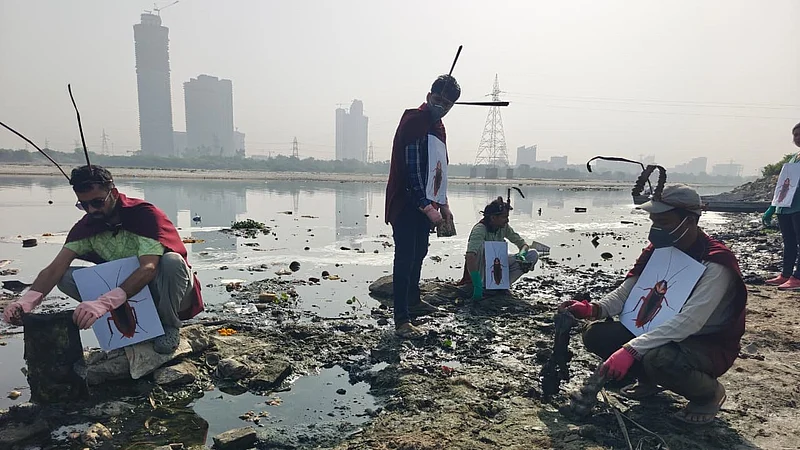
Outlook India documented the remarkable backlash: activists staged a cleanliness drive at Kalindi Kunj wearing makeshift cockroach antennae and carrying placards reading “I am a cockroach.” A satirical Cockroach Janata Party gathered over 55,000 members online within days. Opposition politicians including Mahua Moitra and Kirti Azad publicly joined it.
This is what happens when institutions speak down to the people they exist to serve. The humour is real, but so is the hurt underneath it. Every young graduate sending out hundreds of applications that go nowhere, every first-generation college student who scraped together fees to earn a degree only to find no market for their skills, every RTI activist who has used the law to hold a panchayat or a corporation accountable, they all heard the Chief Justice of India describe people like them as vermin.
The fact that he didn’t mean them, if we accept his clarification, does not erase what they heard. In a country where the employment crisis for educated youth is generational and structurally embedded, comparing unemployable young people to cockroaches, even in passing, even about a narrow class of fraudsters, is a match thrown into a dry field.
The Larger Picture
CJI Surya Kant’s “cockroaches” remark is a microcosm of a deeper institutional failure: the judiciary’s periodic inability to recognise that its language is itself a form of adjudication. Words from the bench define who counts, who is credible, who deserves access.
Fake degrees are a real menace. Frivolous litigation clogs courts. RTI misuse is a genuine problem. But none of these facts required the Chief Justice to reach for the vocabulary of infestation. The legitimate concern — institutional integrity — drowned in the illegitimate vehicle used to express it.
What India’s young people deserve from their Supreme Court is not flattery about being “pillars of a developed India” issued in damage-control press statements. They deserve a judiciary that speaks about them, and to them, with the seriousness and respect that the Constitution demands. They deserve accountability — not as an afterthought, but as a habit of office.
The cockroach antennae at Kalindi Kunj were funny. The underlying message was not.
Anushka Garg is a final-year law student with a keen interest in Constitutional and Administrative Law. She is particularly inclined towards legal research and writing on issues concerning governance, rights, and public policy. Her academic interests also extend to contemporary socio-legal developments and judicial trends. Through her work, she aims to explore the evolving relationship between law, society, and constitutional values.
Read More by Anushka Garg.